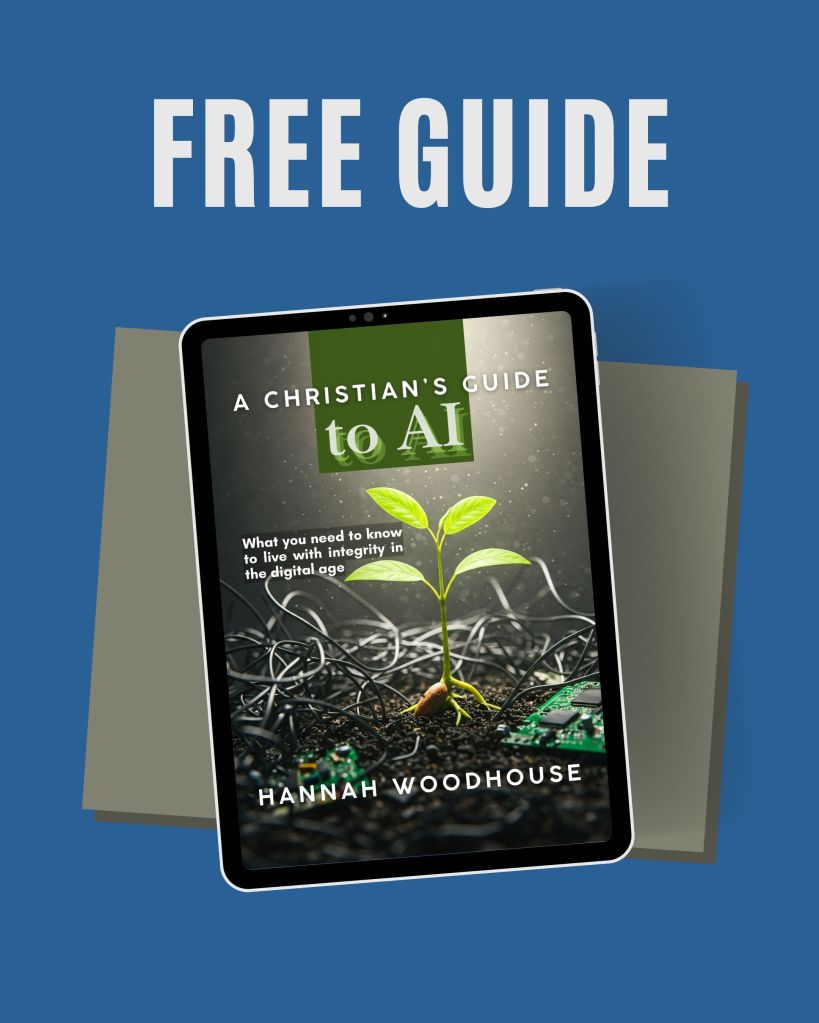
The following is an excerpt from my FREE guide, “A Christian’s Guide to AI.” Click the link to read the full book. Thank you for your support. Please share your thoughts in the comments!
The Benefits of AI
As a creative, AI still gives me the heebie-jeebies sometimes (Merriam Webster recognizes that as a word, so we’re rolling with it). Already, individuals have used AI systems to impersonate others, promote fake news, plagiarize, and outsource critical decision-making. And that’s just the lighthearted stuff. The basic idea is that machines can learn whatever we teach them, which means someone can input another writer’s content into ChatGPT to “create” a report with their name on the byline.
Even worse, individuals have capitalized on AI image-doctoring to falsify news reports and create child pornography. It’s horrible and unsettling, to say the least.
On the flip side, AI is proving to be a positive influence in many arenas:
- Medical Care: AI is helping free up doctors’ time by transcribing notes, summarizing data, and transcribing prescriptions.
- Accessibility: More than 2.5 billion people will need assistive technology in 2030, a problem that’s alleviated by tools such as AI-powered voice technology, AI-powered braille tutoring, virtual reality opportunities, and robotic process automation (RPA). These tools, as well as others, are also allowing more individuals with special needs to embrace autonomy and independence.
- Safety: AI has proven helpful in monitoring workplace safety and proactively addressing risks. One example is forklifts that are now equipped with AI cameras to detect human movement.
- Research: The once-laborious task of organizing and analyzing data is much simpler with AI. I have personally used a system called Julius to analyze large sets of data, saving me over ten hours of manual comparison. AI also helps as we observe wildlife, predict trends, and summarize other research in pursuit of our own.
- Education: A student at MIT recently created an AI-lab assistant, and the machine is effectively accelerating research efforts. According to MIT’s Department of Materials Science and Engineering (DMSE), the assistant can “retrieve and analyze data, switch equipment on and off, and drive robotic arms to mix liquids, for example, or prepare materials for experimentation or analysis.”
As if that’s not exciting enough, AI-powered tutoring and grading bots are transforming academia at all levels–for teachers and students!
- Economic Growth: One of the biggest myths about AI is that it will destroy vocational stability, rendering many without a job. It’s a myth, just like that which preceded the Industrial Revolution. Yes, AI might eliminate 85 million jobs by 2026, but it’s slated to create 97 million new ones, resulting in a net gain of 12 million jobs. So take a deep breath with me and remember that there is nothing new under the sun; robots aren’t taking over the world, or our jobs.
Which Benefit(s) Will You Take Advantage Of?
Many processes that left us groaning in the past are now manageable (or completely avoidable) thanks to AI. You can’t tell me that rapid progress in curing diseases, improved communication for non-verbal individuals, and virtual reality history learning are not positive opportunities!
Before we dive into the not-so-shiny aspects of artificial intelligence–and we will, I promise–I want you to review the information above. Take a minute to truly appreciate this insane technology and how it is displaying the splendor of God. I say this because the lustrous appeal of AI is but a drop in the vast ocean of God’s wisdom. Rather than leaving us feeling like gods, the use of AI ought to give us a glimpse of God.
Try as we might, the combined brilliance of all mankind still falls short. And that should leave us awestruck!
Reflection
Take a minute to reflect on this section and consider how you might be able to see the good in AI.
- What benefits could it bring to your life?
- How do you feel about it in general, thus far?
 A Grateful Life Lived
Leave a comment