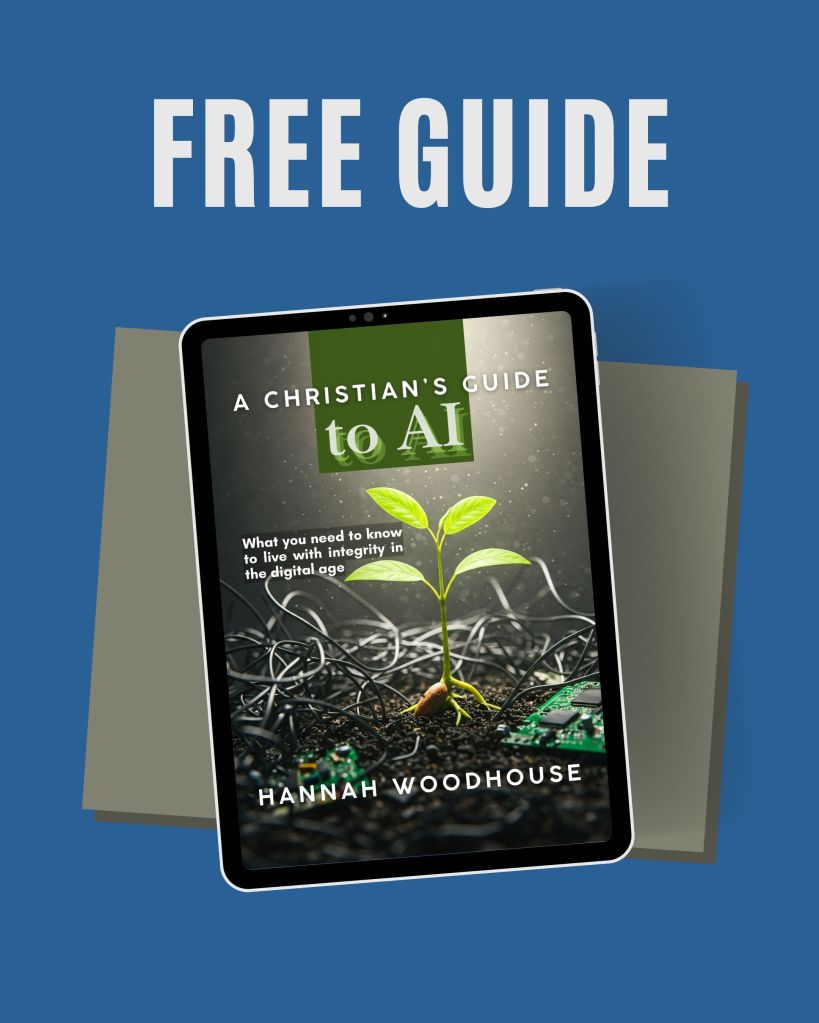
The following is an excerpt from my FREE guide, “A Christian’s Guide to AI.” Click the link to read the full book. Thank you for your support. Please share your thoughts in the comments!
Do you remember the 2023 travesty that was Winnie-the-Pooh: Blood & Honey? It was Pooh’s foray into the horror genre, and it was wild (so I’ve heard–I’ll never watch horror movies).
Per IMDB, the movie’s premise is that Christopher Robin abandons Pooh and Piglet for college, so the duo “embark[s] on a bloody rampage as they search for a new source of food.” Yikes.
(If you wanna go down a rabbit trail, check out some of the stories of schools and parents accidentally playing this movie for their now-scarred children.) Even without anecdotal evidence, however, the departure from Disney’s wholesome character is clear.
This matters because it’s an example of the public domain principles at work. The public domain, in simple terms, refers to creative materials that are not protected under copyright. No copyright lasts forever. In 2022, The Adventures of Winnie the Pooh entered the public domain. This meant that (with some caveats), the original story by E.E. Milne became a content-free-for-all. Less than a year later, Winnie-the-Pooh: Blood & Honey hit theaters.
While interesting, this appropriation is not unique. As AI’s influence grows in the creative industries, so does the thief’s ability to “snatch” others’ work… Why wait for a piece to be released into the public domain if you can create your own book by mixing and matching others’ writing?
Allow me to explain. Let’s say I publish and copyright this guide. If a friend of mine spots an indecent fellow selling reprints of this guide at a festival, I could easily sue for copyright infringement (among other things). But what if that dude took another route? What if he opened up ChatGPT, attached this guide, three other pieces I have published, and a link to my website for more material? What if he asked ChatGPT to use that content to create a new piece of writing about the intersection of faith and technology? He would have pretty good chances of successfully publishing his own content in my voice, with my words and my research. Yikes.
Litigating AI Use
The US Copyright Office has been deliberating on issues of technology and copyright since 1965. At that time, the office preferred looking at these dilemmas on a case-by-case basis. Sixty years later, this stance remains largely unchanged. The office is undertaking extensive research to clarify what warrants a copyright status in the age of AI. While the findings are helpful, the first two reports are largely silent on the issue of AI training using human works. This is a glaring omission for creatives–another bitter reminder that our legislation is lagging behind AI advances. Whether we’re looking at regulations for ethical practice or environmental sustainability, only the European Union has developed a semi-robust AI Act–gradually being implemented in 2025-2026. The US has fragmented ideas and even a collection of “pledges” from AI companies to practice ethically. But that’s it. We are sorely behind.
The NYT vs. Microsoft
In 2024, The New York Times made headlines of its own by suing Microsoft and OpenAI for using copyrighted material from The Times to train its large language models (LLMs). After all, for AI to “work its magic,” it must pull data from countless sources on the internet, which OpenAI claimed falls under fair use access and is 100 percent legal. The case is still open, and the newspaper is still fighting on the basis that people will have no reason to buy a subscription if AI can circumvent the paywall and summarize articles. Open AI, on the other hand, argues that excluding copyright material from training models would effectively dilute its information, eliminating valuable information, data, and stories.
This is where you need to put on your critical thinking cap and look into the nuances of this yourself.
- What would it look like for AI models to present inaccurate or incomplete information?
- What would it look like if AI could access copyright works that are on the web?
AI for Writers
When I mentioned to a coworker that I was writing this publication on AI, he was intrigued. His first question, however, was if I was using AI to write this. The answer is no… and yes.
I like writing for writing’s sake. As I’ve mentioned above, I see tremendous value in the puzzle of words; far too much to let a robot do the task for me. I also have a line I’ve drawn for myself in terms of what I will and will not engage with when it comes to AI writing. That being said, I’ve used AI to summarize fifty-page research studies about copyright, and I used it to create my initial outline. Those are aspects of AI I consider “in bounds.” You have to make these types of value decisions as well.
The beauty of humanity is in our quirks and individuality. It’s something that we risk losing in a society that bends to compilations of writing pieced together by tech. There is a time and place for that, sure. The risk, though, is that we take that boundary and throw it to the wind. If someone can train an AI agent to write like I write, they can also steal powerful tones and rhythms of highly esteemed writers. Beyond theft, the greater loss would be in assimilating our written works because “ChatGPT said it would sound better this way.” I want to circle back to the beginning here, because it is important: AI can only mimic. It cannot create original works, nor can it decide to forgo convention in a nod to an artistic or personal situation. Sometimes, I truly don’t know what I want to write; it just comes out. AI can help with brainstorming, but it cannot enter the chaotic brainspace of puzzling words together. Nor can it create a fleshly being that thinks and breathes and hurts. AI can only give us what we concretely know, what we think we want. That’s incredibly limiting.
As a creative writer, I am constantly considering the impact AI may have on my writing and the craft at large. If you’re in a similar boat, I encourage you to think over the following questions and discuss your thoughts when you get a chance.
- Which aspect of writing is my favorite? How can I protect its integrity?
- How is my writing voice consistent across my pieces?
- How does my creative direction change in a way AI cannot predict?
- Am I using AI to increase my output or outsource my output?
AI for Artists
Image generation was the first popularized aspect of AI. What started as a funny gimmick (think: a generated image of a dog with six legs) is now growing more accurate. While many artists have used AI for inspiration and ideation (definitely a perk), some are using it in more nefarious ways. Whether they are artists or not, the people in the latter group can honestly or dishonestly claim space that used to belong to pure artistry. While there is a place for technology in art, the line is impressionistic.
At the very least, artists can protect themselves with the help of resources like Have I Been Trained (HIBT). The website is a search engine for AI datasets. In other words, it lets users check if AI companies have used their images to train datasets. You can also go one step further and register your domain in the Do Not Train registry–according to HIBT, “this is an additional layer of control and security for individuals who want to retain authority over how their data is used in the rapidly expanding field of AI.”
TL;DR Creative Considerations
You can find more resources like HIBT in the Resources appendix. Ultimately, though, the tension of creativity and artificial intelligence comes down to a collective conviction; a firm stance on what we will and will not protect.


 A Grateful Life Lived
Leave a comment