Do you remember the first time you were made aware of your body?
I do. I was around seven years old. Our family had just left the pool and was buckling in my car when my little brother made a comment. He said something about how the rolls of my stomach (exposed in my swimsuit) bulged over the seat belt. It was an innocent comment from a four-year-old, but I burst into tears immediately.
What I know now is that pervasive cultural messages has been stacking up in my brain. Despite my parents’ conservative rules on media consumption and my Christian education, the concept of “fatness” found its way into my vocabulary (and my little brother’s).
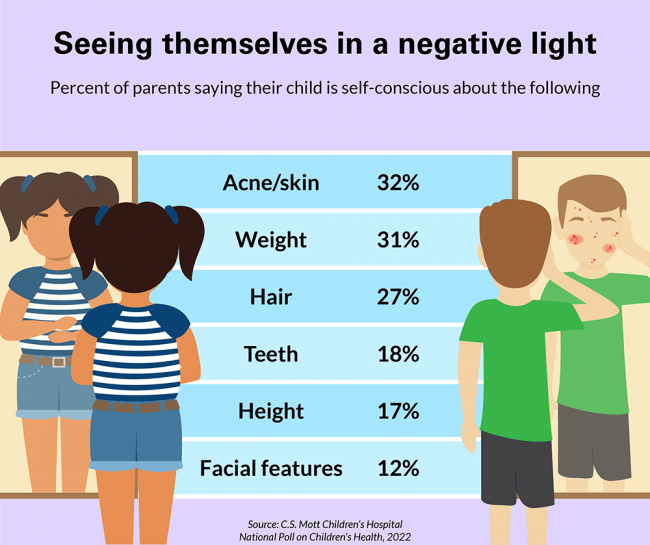
Nearly two thirds of parents say their child is insecure about some aspect of their appearance and one in five say their teens avoid scenarios like being in photos because they’re too self-conscious.
C.S. Mott Children’s Hospital National Poll on Children’s Health at University of Michigan Health.
How old were you when you first had this realization?
A 2022 study from the the C.S. Mott Children’s Hospital found that 57% of girls aged 8-12 are insecure about their bodies. Boys sit just a little lower at 49%. So if you think this is a problem, please think again.
It is not merely impacting “certain” kids—body insecurity impacts people from all ages and backgrounds. Why? Because it’s not just a “beauty problem.” It’s a heart problem.
A (Brief) History on Body Image
We are primed to critique and compare; anything from a clothing choice to someone’s hairstyle is grounds for ostracization. This is not new to the twenty-first century. Yes, the comparison game is amplified by global media and the internet, but its impact is documented further back, as well. Literature from the Victorian era shows that by the 1880s, culture had already given obesity a moral dimension (that is: fat shaming was already prominent, equating larger bodies with laziness or a lower moral standing).

Make no mistake, though. Humanity’s war against our bodies is as old as, well, some curious fruit-picking in the Garden of Eden. The moment that Adam and Eve disobeyed God, they realized they were naked (Gen. 3:7). The nakedness, which had never been a problem before, became a source of shame. Why though? They didn’t suddenly become ugly.
When Adam and Eve ate the fruit (Pomegranate? Apple? I have no clue), Scripture says their eyes were opened to the knowledge of good and evil. As one hermeneutical note shares (FYI: hermeneutics is a fancy word to describe the study of the principles and methods for correctly studying the Bible), Adam and Eve’s awareness came with a cost:
“It was not revelation of some sin that they had done that made them ashamed.
But rather, it was knowing the “Good” that they had not clothed themselves in, that made them ashamed, (the “Good” imitation of the love and mercy of God – righteousness).”
Blending in & Hiding Shame
In an attempt to hide their shame and appear “good enough” (keep in mind that this is a very-simplified explanation), the couple covered themselves in clothing. Ever since then, the desire to appear “good” and hide from shame has plagued humanity. Just like Adam and Eve, we often try to hide our shame by looking around and reading the room–What is everyone else wearing? What do others look like? Am I too different? We try to reconcile our otherness by blending in, just like Adam and Eve (albeit in a different fashion).
“Just like Adam and Eve, we often try to hide our shame by looking around and reading the room…”
If you’ve read this far, it’s likely because you are aware that all the shopping sprees, steroids, and cosmetic work in the world fail to fix our broken sinful nature. But that doesn’t mean we don’t still try, yes? It seems like an easy fix to go to the next wellness trend rather than bring our insecurity to God. It takes crippling courage to confess that we feel that we fall short and need God to clothe us in His truth; we don’t need to match a worldly standard to prove we are good enough.
The Good News
The good news for those who trust in Christ is that our shame—that inadequacy and loneliness that strike when we look at a picture perfect world around us—is fully cleansed. King Jesus lived the perfect life we cannot and He gave that life to cover our nakedness. This means that when we feel the weight of our sin or simply the brokenness in the world that causes aging, disease, pain, and failing bodies; we don’t need to cover ourselves. We have an Advocate who loves us and sees us as He made us to be.
At this point, I feel like I’m rambling. So at the risk of treading into deep theology I don’t quite have a grasp on, I am going to end here. What I’m hoping to communicate is that our default desire to fill our physical void–body physique, clothing, makeup, status–is a sin pattern. In Christ, we have the ability to find the fullness of our worth in Him (no that doesn’t mean beauty or self-care are bad, but that’s for another day).
Hope for the Next Generations
My heart aches when I consider how youth are impacted by the lies our world so readily shares. As Christians, we need to be prepared to give a reason for the hope that lies within (1 Peter 3:15). In the coming months, I hope to build on this article by creating a series and perhaps a workbook… I want to create dialogue and help equip parents and Christian adults to serve younger generations. We can play a role in changing the pattern. By God’s grace, I am doing my part.
Let me know which subtopics and questions you’d love me to cover. A few you can look forward to include:
- Age-appropriate, gospel-centered ways to discuss body image with children
- How to practically be a good role model for young people around me
- Breaking down feelings about our bodies that are rooted in lies from the enemy
- Recommended resources for various age groups and body image struggles
- Foundational truths and affirmations to combat negative self-talk
- Humility vs. thinking badly of oneself (is there a difference!?) – there is 🙂
As always, thank you for your support and heartfelt feedback.
Love,
Han
Additional Resources on Body Image and Mental Health

Lessons Learned in Therapy: “Food Has No Moral Value”
We need phrases like, “food has no moral value.” Why? Because we live in a world that says food is “good” or “bad.”

Lessons Learned in Therapy: “That’s Not For Me”
If you’ve ever found yourself bending to the pressure of peers, tabloids, and/or random “experts,” you aren’t alone. Allow me to introduce you to your new best friend: “That’s not for me.

Holidays and Eating Disorders: A Message for Loved Ones
If you are struggling with an eating disorder, this letter might be a helpful piece to share with those you love. Please know that you aren’t alone. If your need is urgent, please call the toll-free, confidential NEDA…
 A Grateful Life Lived
Leave a comment