1. I don’t know my weight
In general, I don’t find weight monitoring to be helpful. There is ample research to support this, for what it’s worth. Unless you have a very niche medical concern, body weight is an incomplete, limited, and unreliable measure of health. This is because body weight combines ever-shifting numbers such water weight, muscle mass, and menstrual fluctuations for women, to give you one grand number. It omits other indicators of health such as mental wellness, health history, lifestyle, and more [Read More]. The number doesn’t mean much, AND YET our society is pretty tied to it as a sign of worth. So much so, that I used to obsess over keeping that number the same.
That number no longer dictates my opinion of myself—somewhat because I’ve chosen to not know it in order to give space for further healing. Sure, I’ve accidentally seen my weight when doctors or nurses have slipped up, but I do my best to glance away and forget it. Unfortunately, the number still has some power over me, and that’s okay. It’s not important anyway. Thus, it doesn’t get to be a part of my life—or my pregnancy journey.
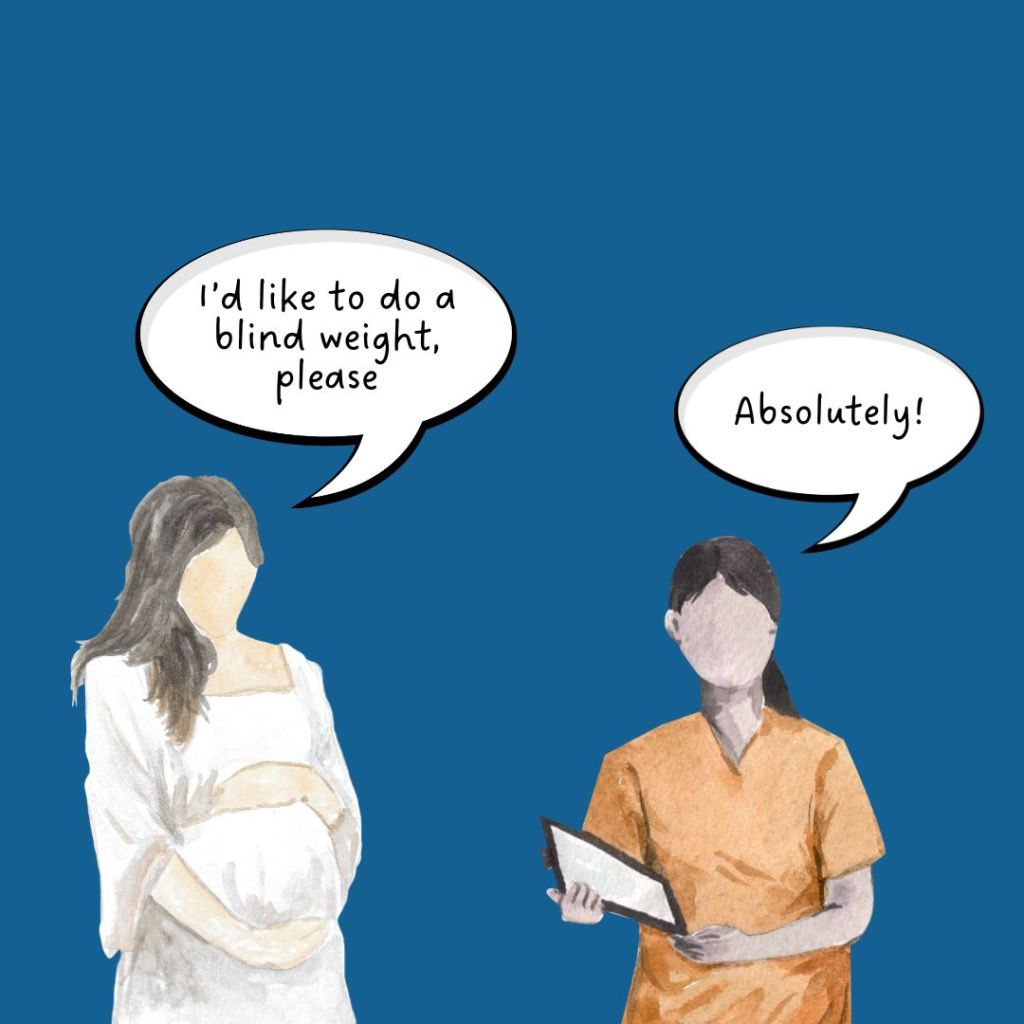
In regard to the latter: Yes, weight is relatively important when measuring the growth of a baby. You may decide, like I have, to allow your doctor to do a blind weight (i.e. stand backward and ask them to not put the weight on patient-facing documents). But even in terms of a healthy pregnancy, there is a wide range of “healthy” because all bodies are different.
The bottom line is: You don’t need to know your weight, and if the thought of weigh-ins gives you anxiety, opt out of knowing that number! Doing so has allowed me to free up brain space for more important focuses—parenting prep, prayer for my baby, and listening to my body’s cues!
“You don’t need to know your weight, and if the thought of weigh-ins gives you anxiety, opt out”
2. I am prioritizing movement that feels good
I had a fraught relationship with exercise from the age of 15 to 28ish. So I am the first to say that it’s no easy task to simply “let go of control.” It continues to be a long-term process, and some months are harder than others. On the whole, though, I have found that our bodies are incredibly good at telling us what they need—be it rest, stretching, nourishment, or a switch-up in routine.
Looking back, I wish I’d been more gracious with myself during the first trimester. I agonized over what elite athletes do to maintain their fitness routine; I sacrificed work for exercise at times. At the same time, I made a lot of progress from my rigid eating disordered relationship with movement.
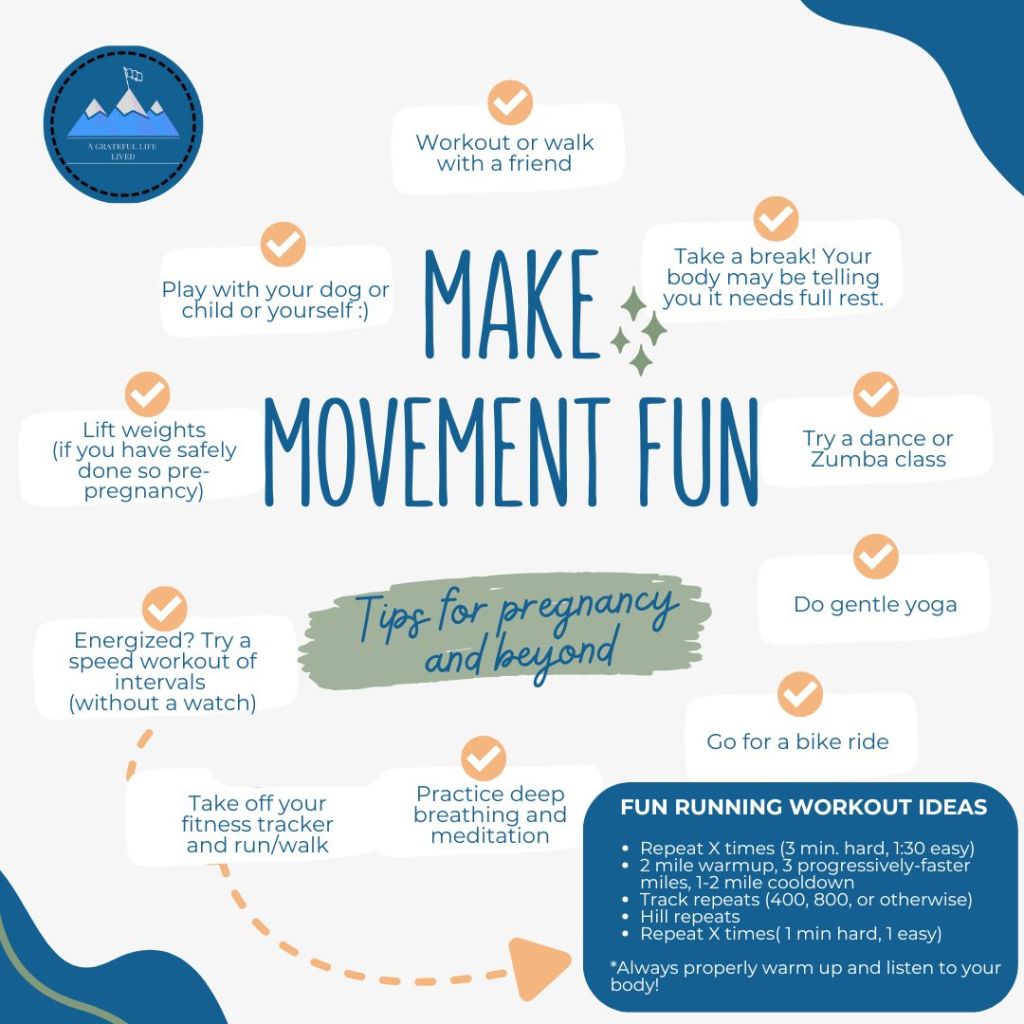
Nowadays, I am meditating on gratitude for what God’s allowed my body to do—for the first time, this is largely not performance/athletically based. My pace has slowed a bit (although I feel a zillion times better than the first sixteen weeks of pregnancy). My body is changing in ways that aren’t speed-oriented. My energy is less abundant. What’s also true is that I am allowed to experience different seasons of life with my body and movement. If running sounds too hard, I go to a spin class or try Zumba. If I feel like I’m dragging myself to get to the gym, I use coping skills and choose rest over movement.
It is HARD. And, I know this growth is something that will provide long-term health and enjoyment in sport as well as life. Allowing for fluctuation goes against every disordered and OCD thought that I am used to, and that is a good thing.
If you are in a similar stage of newness—whether pregnant or not—I encourage you to give yourself space from comparison-tempting tools. If Strava, Garmin, or other resources are more anxiety-producing; log off. I have also found it fun to mix up any hard efforts I do, so I don’t compare my fitness week to week—tempo, interval, track stuff, hills, and more—if I feel excited to run hard (which I have, lately!).
3. I focus on celebrating physical changes and acknowledging that change is scary
I have long-since joked that I have a leg-up on other pregnant women, as I’ve gone through the full weight restoration process of eating disorder treatment, two times in my life. Gaining weight while growing a baby is different, but it presents similar anxieties—ones I’ve had to navigate before.
What has helped me, then and now, is reminders of Scriptural truth and value. My value is not in what I do, nor do I find joy in exerting complete control over my life—that only leads to a fast-shrinking, scary world.
Instead, I am fixing my eyes on the things of God (Phil. 4:8) and rejoicing in the reward of a new baby on the other side of this process. This can be scary, and I admit that when it comes up; I also remind myself that I can do scary things and that this is worth it!
4. I limit the media I consume (specifically in relation to pregnancy)
Number four is a growth-point, for sure. I don’t know many women (or men, for that matter) who feel at ease with their media consumption. I do a lot better than I used to, yet I find comparison so easily-elicited via social media. To combat that, I’ve gone into settings on Instagram to curate my profile. I’ve unfollowed or disliked content that promotes toxic-wellness—in pregnancy or otherwise. I have saved content that celebrates diverse bodies, pregnancy experiences, and intuitive rest/movement.
It alarms me how many people are publicly endorsing intense workout regimes, extreme “clean eating,” and “bump only” pregnancies online. I have seen how damaging that restrictive perspective is, and I don’t want to let it weasel its way in to a sacred season of my life.
Whenever you or I are ruminating on body changes, “food noise,” or other changes; we benefit from leaning into what the Lord says is true: We are fearfully and wonderfully made. Most of us (barring those with significant health challenges) have the blessing of listening to our bodies and respond to their cues (FYI: intuitive eating is more than just “I’m hungry. I eat.” It includes practical hunger).
My body has probably gained more weight than some women during pregnancy. My body has probably gained less weight than some women during pregnancy. I can’t fixate on that.
God has designed our bodies to “do” pregnancy—and life—in certain ways. So, manipulated our bodies via restriction or excessive exercise is nothing less than “playing God.”*
*Note on this
I didn’t understand or choose to manipulate my body purposefully in the depths of my eating disorder (ED). None of us do. That is because EDs are not a choice, nor do they allow for individual choice. An ED really mess up a person’s brain and does not allow for rational thinking. So please, don’t hear me say that an ED is a sin; that is far from the truth. Rather, understand that healing allows for clear-minded thinking and the ability to make different choices. That is what I am choosing to do now that I can.
5. I consider how I would want my daughter to hear me talk about or consider my body
We often think that the secret to raising resilient and confident kids is to encourage them in a growth-mindset manner. That is true. At the same time, I firmly believe that a key indicator of a child’s relationship with his or her body is how his/her parents talk about their bodies.
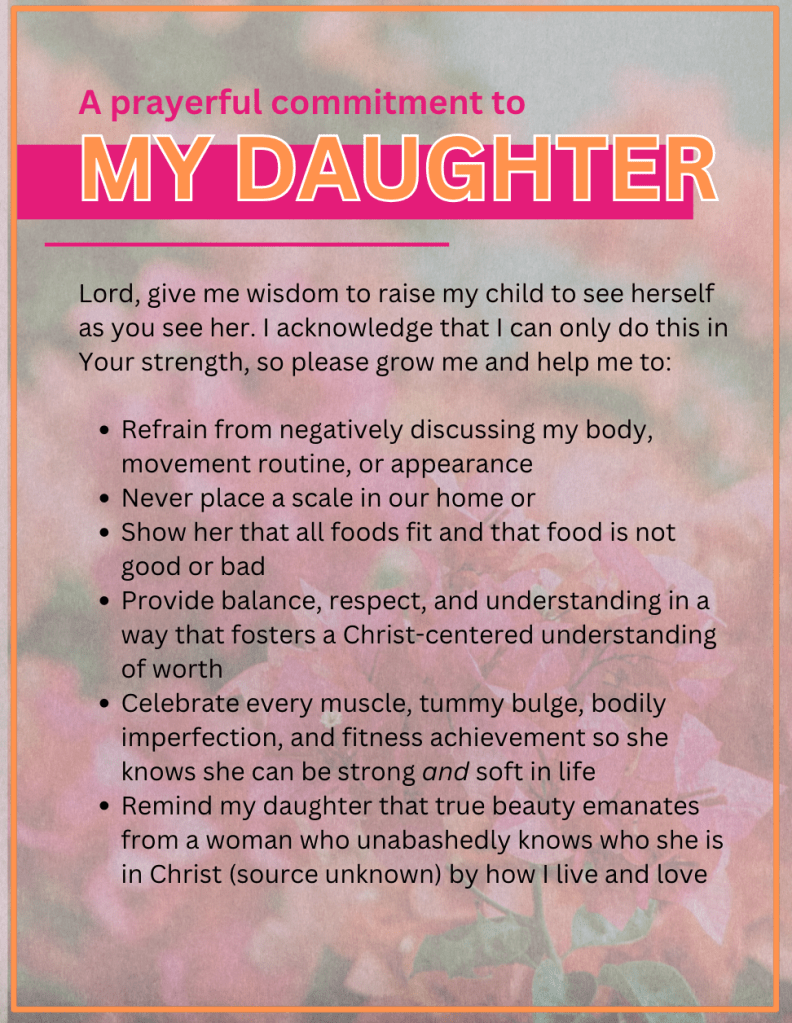
My daughter will not grow up hearing me negatively discuss my stomach, movement routine, or appearance. She will not see a scale in our home or a mommy who designates “good” foods and “bad” foods. By God’s grace, I will provide balance, respect, and understanding that fosters a Christ-centered understanding of who my daughter is. With His help, I will celebrate every muscle, tummy bulge, bodily imperfection, and fitness achievement that I can—reminding my daughter that true beauty emanates from a woman who unabashedly knows who she is in Christ (source unknown).
This is my commitment and prayer—only possible in Christ because of the work He has done through eternity and in my personal life (check out the printable version I’ve created below, available in color and black/white).
Love,
Han



 A Grateful Life Lived
Leave a comment